Africa is home to the world's youngest population, its fastest-growing economies, and an entrepreneurial energy that rivals anywhere on Earth. Yet the infrastructure to channel that energy into commerce — to let creators sell, businesses scale, and customers buy with confidence — remains painfully incomplete.
Porsa exists to change that. We are building the commerce operating system for Africa: a single platform where anyone can build a store, accept payments, fulfill orders — physical and digital — and operate in full compliance across borders. No patchwork. No workarounds. Just infrastructure that works.
The continent is not short on ambition. It is short on operational rails — the invisible layers that turn an idea into a functioning business. Every day, thousands of entrepreneurs across Africa hit the same walls: fragmented payments, unreliable fulfillment, opaque regulatory requirements, and a trust deficit that makes customers hesitant to buy online.
Africa operates with over 40 different currencies, hundreds of mobile money platforms, and a patchwork of card networks that rarely interoperate seamlessly. A creator in Senegal who wants to sell a digital course to a customer in Kenya faces a labyrinth of payment methods: Orange Money, M-Pesa, local cards, international cards, bank transfers — each with its own integration, settlement timeline, and fee structure. Research shows that 42% of African businesses report payment gateways as a major constraint to their growth.
The result? Lost sales. Abandoned carts. Revenue that never materialises because the payment experience was too complex for the buyer — or too expensive for the seller. Many merchants are forced to cobble together three or four different payment providers just to cover their addressable market, each adding operational overhead, reconciliation headaches, and integration risk.

Delivery times in sub-Saharan Africa average 10–14 days compared to 2–5 days in developed markets. In many regions, addresses are informal, last-mile networks are sparse, and the cost of shipping can exceed the value of the product itself. For physical goods, this turns every transaction into a gamble — both for the merchant who ships and the customer who waits.
For digital goods, the challenge is different but equally real: there is no standardised delivery rail for e-books, courses, software licences, or digital services. Creators resort to email attachments, file-sharing links, or manual delivery — none of which can be tracked, secured, or scaled. The absence of fulfillment infrastructure — physical and digital — is one of the single largest barriers to e-commerce growth on the continent.
Only 28% of Africa's population is currently online, and for many of those who are, e-commerce remains an act of faith. Without established buyer protection, transparent return policies, or recognisable merchant credentials, customers are understandably cautious. In markets where cash-on-delivery still dominates, every online purchase is a leap of trust — and too often, that trust is broken.
Meanwhile, 52% of businesses cite internet connectivity as a major obstacle, meaning the digital storefronts that do exist must be fast, lightweight, and resilient. The gap between what African consumers want to buy and what they feel safe buying online represents billions of dollars in unrealised commerce.

Africa comprises 54 sovereign nations, each with its own tax code, consumer protection statutes, data privacy regulations, and import/export rules. A merchant in Côte d'Ivoire selling to Nigeria must navigate VAT obligations, customs duties, currency restrictions, and compliance requirements that shift from country to country — and sometimes from month to month.
For small businesses and solo entrepreneurs, regulatory compliance is not just a burden — it is a barrier to entry. Without dedicated legal teams or compliance infrastructure, most merchants simply cannot sell cross-border. The result is a continent of walled-off domestic markets, each too small to sustain the growth that African businesses need and deserve.

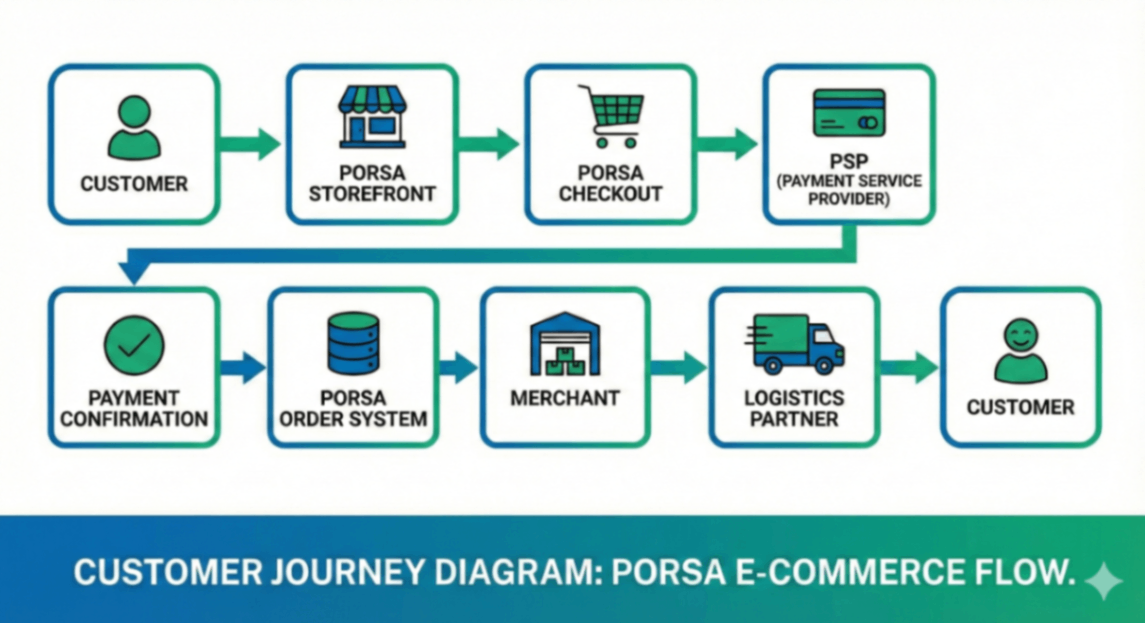
Porsa replaces the patchwork. Instead of stitching together five different tools, three payment providers, two logistics partners, and a spreadsheet for compliance tracking, merchants get a single unified platform that handles everything from storefront to settlement, from listing to last-mile, from tax calculation to customer support.
Launch a professional, mobile-optimised storefront in minutes — no developers required. Choose from templates designed for African markets, with built-in support for product catalogues, service listings, digital downloads, and appointment booking. Every store is fast, lightweight, and built to convert on low-bandwidth connections.
Accept every payment method your customer prefers — mobile money (M-Pesa, Orange Money, MTN MoMo, Wave), local and international cards, bank transfers, and USSD — through a single integration. Automatic currency conversion, real-time settlement tracking, and transparent fee structures mean you never lose a sale to payment friction.
Sell e-books, courses, software, templates, music, design assets, and any digital product with instant, automated delivery. Secure download links, licence key generation, access expiration controls, and download tracking are all built in. No more emailing files or managing Google Drive folders — just professional, scalable digital commerce.
Integrated logistics partnerships that handle warehousing, picking, packing, and last-mile delivery across African markets. Real-time tracking, automated shipping rate calculations, and delivery confirmation give both merchants and customers confidence that every order will arrive. We are solving the 10–14 day delivery gap one route at a time.
Porsa acts as the legal seller for every transaction. We handle tax collection and remittance, regulatory compliance, buyer protection, refund management, and dispute resolution across every market you operate in. You focus on creating and selling — we handle the legal and financial complexity of cross-border African commerce.
Generate shareable payment links and sell directly through WhatsApp, Instagram, Telegram, Facebook, or any messaging platform. No storefront required. Perfect for service providers, freelancers, and anyone who sells where their customers already are. Each link is a complete checkout experience — product details, payment, and fulfillment in a single flow.
We believe African commerce needs exactly four systems working in concert: Payments, Fulfillment, Compliance, and Customer Experience. When all four exist on a single platform — designed for African realities, not retrofitted from Western templates — something remarkable happens: commerce just works.
Payment is the heartbeat of commerce. In Africa, that heartbeat operates through a uniquely diverse ecosystem — mobile money wallets that move more value than bank transfers in many markets, local card schemes that coexist with Visa and Mastercard, USSD codes that serve the unbanked, and bank transfers that remain the default for B2B transactions.
Porsa's payment layer unifies all of these behind a single checkout. Customers pay the way they prefer. Merchants receive funds in the currency they choose. Settlement is transparent, predictable, and fast. We handle the complexity of multi-rail payment orchestration, fraud screening, and currency conversion so that every transaction — whether it is a $2 digital download paid via M-Pesa or a $500 product order paid by Visa — settles cleanly and on time.
A sale without delivery is not a sale — it is a promise. Porsa's fulfillment infrastructure ensures that every promise is kept, whether the product is a PDF e-book delivered instantly or a physical item shipped across borders.
For digital products, we provide secure, automated delivery with download tracking, licence management, and access controls. For physical goods, we integrate with logistics networks across Africa to provide real-time tracking, shipping rate calculation, customs documentation, and delivery confirmation. Our goal is to compress the 10–14 day delivery average into something that approaches the 2–5 day standard that African consumers deserve.
Compliance is the invisible tax on cross-border commerce. Each of Africa's 54 countries has its own VAT rates, import duties, consumer protection laws, data privacy regulations, and business registration requirements. For a solo creator or small business, understanding — let alone complying with — these rules across multiple markets is practically impossible.
As Merchant of Record, Porsa absorbs this complexity entirely. We are the legal seller on every transaction, which means we handle tax calculation, collection, and remittance. We manage regulatory filings, maintain licences, and ensure that every sale complies with local law. Ghana's e-customs system reduced clearance times from 10 days to 2 hours — we bring that same modernisation mindset to the entire compliance stack.
Infrastructure is only valuable if the end customer feels its benefit. Porsa's customer experience layer ensures that every touchpoint — from discovery to checkout to delivery to support — meets the standard that African consumers increasingly demand. Fast-loading storefronts optimised for mobile. Checkout flows that respect local payment habits. Order tracking that builds confidence. Post-purchase communication that builds loyalty.
Our Client Platform gives buyers a single place to manage their orders, track deliveries, access digital purchases, request returns, and communicate with merchants. It is the kind of experience that builds repeat purchasing behaviour — and repeat purchasing is how e-commerce markets mature.
The Merchant of Record model is the secret weapon of the world's most successful digital commerce platforms. Porsa brings this model to Africa for the first time — purpose-built for the continent's unique regulatory, financial, and operational landscape.
When a customer buys through Porsa, the legal seller on the transaction is Porsa — not the individual merchant. This means Porsa is responsible for collecting and remitting taxes, managing refunds and chargebacks, complying with consumer protection laws, and handling regulatory filings in every market where the sale occurs.
For the merchant, this is transformative. Instead of registering a business entity in every country you sell to, instead of hiring accountants who understand local tax law, instead of building compliance workflows from scratch — you simply list your products and sell. Porsa handles the rest.
This is not a minor convenience. For creators, freelancers, and small businesses across Africa, the Merchant of Record model is the difference between selling in one country and selling across the continent. It removes the single largest barrier to pan-African commerce: the regulatory patchwork that makes cross-border business prohibitively complex.
$940B
African e-commerce market projected by 2032
500M
African shoppers expected online by 2025
54
Countries with unique regulatory frameworks
42%
Businesses citing payment gateways as a constraint
Most commerce platforms were designed for North American or European markets and then "localised" for Africa — a process that typically means adding a few payment methods and translating the interface. Porsa takes the opposite approach. Every decision — from our payment architecture to our fulfillment model to our pricing structure — starts with African realities.
In sub-Saharan Africa, 57% of adults use mobile money — more than any other region on Earth. Mobile money processed $1.3 billion in transactions in 2022, and it is the primary financial tool for hundreds of millions of people who have never held a bank card. Any commerce platform that treats mobile money as a secondary payment method has fundamentally misunderstood the African market.
Porsa was designed with mobile money at the centre. Our checkout flow presents mobile money options first in markets where wallet payments dominate. Our settlement system is optimised for the unique characteristics of mobile money networks — batch processing, USSD confirmation flows, and the latency patterns that differ from card-based systems. This is not localisation. This is native design.
Africa operates with over 40 currencies, many of which have restricted convertibility, volatile exchange rates, and limited availability on international FX platforms. A merchant in Rwanda selling in Rwandan Francs to a customer paying in West African CFA Francs needs more than a simple currency converter — they need a payment system that understands the correspondent banking relationships, settlement delays, and regulatory constraints that govern cross-currency African transactions.
Porsa's multi-currency engine handles all of this transparently. Buyers see prices in their local currency. Merchants receive settlement in their preferred currency. Exchange rates are locked at the point of sale, eliminating FX risk. And our transparent fee structure means there are no hidden markups buried in conversion spreads.
Where other platforms see Africa's regulatory diversity as a problem to avoid, we see it as an opportunity to create value. The African Continental Free Trade Area (AfCFTA) connects 1.3 billion people with a combined GDP of $3.4 trillion — the largest free trade area in the world by number of countries. As AfCFTA implementation accelerates, the businesses that are already set up for cross-border compliance will be the ones that capture the largest share of intra-African trade.
Porsa's compliance infrastructure is designed to evolve with African regulation. As new tax treaties are signed, as customs unions expand, as digital commerce frameworks are adopted — our system updates automatically. Merchants do not need to track regulatory changes. They just sell. We handle the complexity and unlock the opportunity.
Porsa is not a niche tool. It is horizontal infrastructure — designed to serve any business that needs to sell, fulfill, and get paid in African markets. Whether you are a solo creator selling your first digital product or an international brand entering the continent, Porsa provides the foundation.
Writers, course creators, designers, musicians, and educators who want to monetise their expertise across African markets. Sell e-books, online courses, templates, music, and digital assets with instant delivery, secure access controls, and multi-currency payments. No technical skills required — just create and publish.
Learn moreConsultants, developers, designers, coaches, and freelancers who need professional invoicing, payment collection, and service delivery infrastructure. Create payment links, send professional invoices, collect deposits, and manage client relationships — all through a single platform that handles compliance across borders.
Learn moreProduct-based businesses that need a complete e-commerce stack: storefront, inventory management, payment processing, shipping integration, and customer management. Porsa provides everything you need to run a professional online store in African markets — without the technical overhead of integrating multiple vendors.
Learn moreBusinesses that sell both digital and physical products — training companies with courses and merchandise, authors with e-books and print editions, fitness coaches with video programmes and supplements. Porsa uniquely supports both digital and physical product fulfillment in a single store, a single checkout, and a single dashboard.
Learn moreGlobal brands and companies expanding into African markets for the first time. Porsa serves as your operational layer on the continent — handling payments, compliance, fulfillment, and customer experience without requiring you to establish legal entities, local bank accounts, or regional offices. Enter 54 markets through a single integration.
Learn moreWhatever you sell and however you sell it — if your market is Africa, Porsa is the foundation you build on. We are not a template solution. We are infrastructure that adapts to your business model, your markets, and your growth trajectory.
Get started freeAfrica is not a future market — it is already the world's fastest-growing consumer market. The data tells a story of enormous demand colliding with insufficient infrastructure. Porsa is built to close that gap.
$940B
Africa's projected e-commerce market by 2032
1.3B
People connected by AfCFTA with $3.4T GDP
57%
Sub-Saharan Africa adults using mobile money
500M
African shoppers expected online by 2025
$1.3B
Mobile money transaction volume in 2022
52%
Businesses citing connectivity as a major obstacle
10→2hrs
Ghana e-customs clearance time reduction
28%
Africa's population currently online
The history of economic development shows that transformative growth does not come from individual apps or services — it comes from infrastructure. Roads enabled trade. Electricity enabled industry. The internet enabled information. Commerce infrastructure will enable the next chapter of African economic growth.
Porsa is that infrastructure. We are building the rails that will carry Africa's commerce for the next decade and beyond. Not a marketplace that competes with merchants. Not a payment processor that only solves one piece of the puzzle. A complete operating system that lets anyone — from a student in Dakar selling study guides to a manufacturer in Nairobi exporting to 15 countries — participate in the digital economy with the same tools and protections that merchants in London or New York take for granted.
This is a long-term commitment. Infrastructure is not built in a quarter. It is built over years, with relentless focus on reliability, coverage, and trust. Every product we launch, every market we enter, every partnership we form is in service of a single mission: making commerce frictionless across Africa.
2024
Platform launch & initial markets
2025
Pan-African expansion & logistics
2026
Full MoR coverage across AfCFTA
2030
Commerce backbone for the continent
Porsa is guided by a set of convictions about how commerce infrastructure should work in Africa. These are not marketing slogans — they are the engineering and business principles that shape every decision we make.
We do not chase trends or build gimmicks. We invest in deep, reliable infrastructure — payment rails, delivery networks, compliance systems — that will still be critical in ten years. Features are easy to copy. Infrastructure is not.
The best infrastructure is invisible. Merchants should not need to understand payment orchestration or tax law. They should just sell. Our job is to absorb complexity and present simplicity — a clean dashboard, a working checkout, a reliable payout.
It is better to work reliably in twenty markets than to half-work in fifty. We expand methodically, ensuring that every market we enter has full payment coverage, compliance support, and fulfillment capability. Breadth without depth is not infrastructure — it is a demo.
Our success is measured by merchant outcomes: revenue generated, orders fulfilled, markets entered, problems solved. We are aligned with our merchants because our business model depends on their success. When they grow, we grow.
Clear pricing. Honest fees. No hidden charges in currency conversion or settlement. No proprietary formats that trap your data. Merchants should choose Porsa because it works, not because it is difficult to leave. Trust is earned through transparency.
We build for African realities but hold ourselves to a global standard. Mobile-first design, enterprise-grade security, world-class developer experience. Africa deserves infrastructure that is not "good for Africa" — it should be good, period.
Every day, African entrepreneurs lose sales to payment failures, fulfillment gaps, and compliance complexity. Porsa exists to make those losses a thing of the past. Join the merchants who are building their businesses on real infrastructure — and reach customers across the entire continent.
Free to start. No credit card required. Set up in under 5 minutes.